As organizations grow in complexity and scale, different governance and execution offices are established to ensure effective delivery of projects, programs, and strategic change. Three commonly used constructs are the Project Management Office (PMO), Enterprise Project Management Office (EPMO), and Transformation Management Office (TMO). While they are related, each serves a distinct purpose.
Project Management Office (PMO)
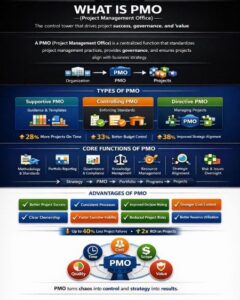
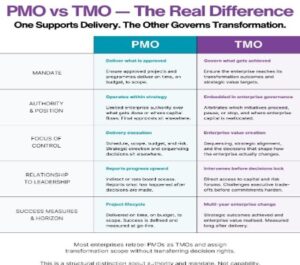
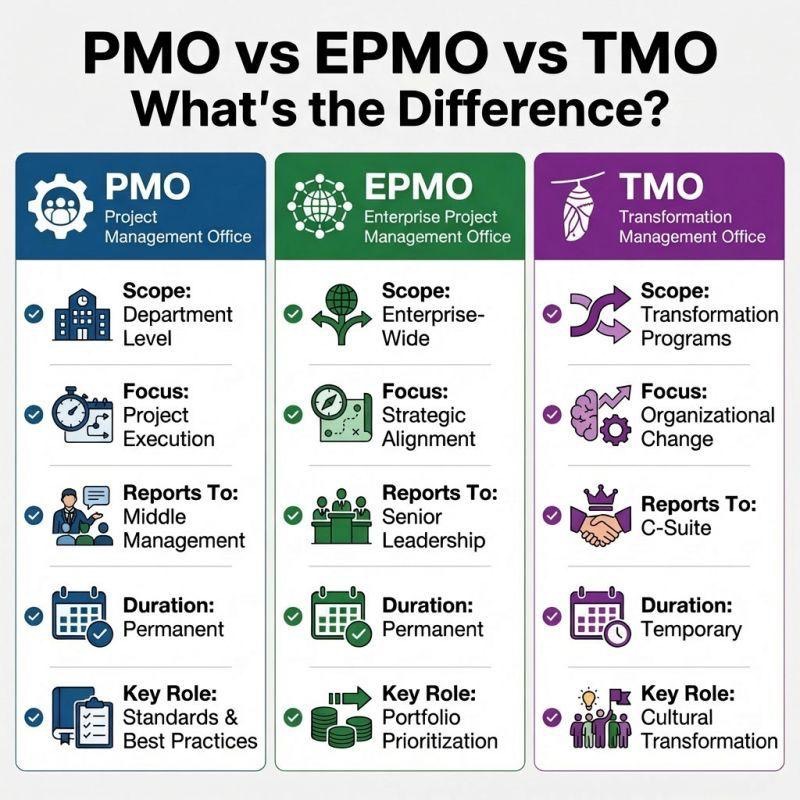
A PMO focuses on the execution and governance of projects within a specific function, department, or business unit. Its primary role is operational ensuring projects are delivered on time, within scope, and within budget. PMOs define project management standards, provide tools and templates, track project progress, and support project managers in day-to-day delivery.
In Crux: PMO is about doing projects right.
Enterprise Project Management Office (EPMO)
An EPMO operates at the enterprise level and has a broader, more strategic mandate. Instead of managing individual projects, it oversees the entire project and program portfolio across the organization. The EPMO ensures that initiatives are aligned with organizational strategy, investment priorities, and value realization goals. It supports executive decision-making by providing portfolio insights, governance frameworks, and performance transparency.
In Crux: EPMO is about doing the right projects.
Transformation Management Office (TMO)
A TMO is typically established to drive large-scale, strategic transformation initiatives, such as digital transformation, operating model changes, mergers, or cultural shifts. Unlike PMO and EPMO, the TMO is outcome focused, emphasizing benefits realization, change adoption, and business impact. It integrates program execution with change management, communications, leadership alignment, and value tracking.
In Crux: TMO is about delivering strategic change and sustained business outcomes.